 What's so special about Granada?
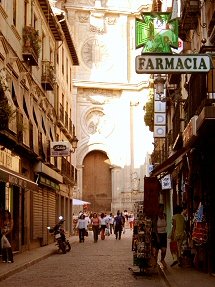
Suddenly, Granada is the most popular destination for Britons coming to live in Spain. So what's the big attraction? Granada has been described in travel guides as the South of Spain's best-kept secret. It is only in the last few years that visitors to the country have begun to discover just how much the city and the region have to offer, both as a place to live and as a holiday destination. In the past, most foreigners - and especially Britons - coming to live or buy holiday homes in Spain gravitated to the stretch of coast between Gibraltar and Malaga, with very few venturing further eastwards than the town of Nerja, or further inland than a few kilometres. Until recently, the vast majority of British exiles bought property and lived along this narrow strip of the Costa del Sol. There were a number reasons for this, but by far the most important factor was the proximity of Malaga airport, which offered daily flights to London and most other major cities in the UK and Europe. Most Britons moving to the South coast of Spain wanted to live within a short driving distance of the airport.  However, there were other factors which deterred new arrivals from visiting or buying property further along the coast. For one thing, the roads were poor, and offered little in the way of services or amenities. Driving long distances in hot weather was also something to be avoided, especially in the days before cars had efficient cooling systems. And driving at night was no less off-putting, in view of the fact that most of the twisting roads along the coast - some skirting the edges of steep, unguarded precipices - did not have lighting. Britons, for the most part, felt safer and more at home in and around Malaga - where, additionally, English was widely spoken.
Things have changed dramatically over the last several years. Thanks in large part to popular British TV programmes like "A Home in the Sun," and "Living in the Sun" (GranadaProperties.com assisted in the making of the latter) - which set out to explore locations off the beaten tourist and expatriate track - people in the UK who were thinking of moving to Spain discovered that the Costa Tropical - the coastline between Nerja and Almeria - had as much, if not more, to offer than the now overcrowded and overpriced Costa del Sol. 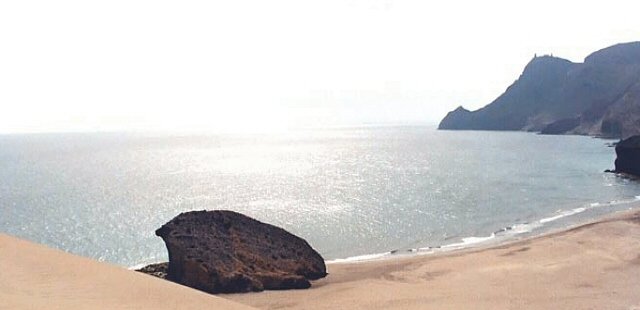 The Costa Tropical beaches were better, to begin with - and were still largely devoid of humans. As the area had avoided the excesses of the 1960s property development frenzy, there were none of the high-rise buildings that blight so much of the Costa del Sol sea-front . The roads here had little traffic, and the countryside was still largely unspoilt. But, perhaps most crucially, property prices along the Costa Tropical were substantially lower than those of del Sol.
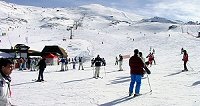 It also came as something of a revelation to most Britons that there was a first-rate ski resort in Granada (Spain is associated in most British peoples' minds with sunshine and golden sand, not with snow!), and that it was possible to ski on the slopes of the Sierra Nevada mountains in the morning and spend the afternoon sunbathing on the deserted golden beaches of Almeria. Most visitors to the Costa Tropical are amazed to discover that it is only an hour's drive from the Granada ski resort - the most southerly in Europe - to the Mediterranean coast.
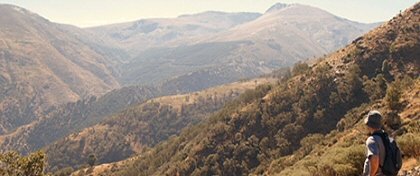 Then articles began to appear in British magazines about Granada's natural park - more than 300 square miles of open, unspoilt countryside encompassing mountains, rivers, forests, lakes, abundant wildlife (including many rare species), exotic birds and insects, natural springs and blue lagoons of crystal-clear water - all less than an hour's drive from the centre of Granada city! For those interested in outdoor activities like rambling, cycling, horse-riding, rock climbing and so on, and for those interested in exploring nature, the prospect of having this magnificent natural resource on their new doorstep was a huge, additional incentive to head for the Granada region. Then articles began to appear in British magazines about Granada's natural park - more than 300 square miles of open, unspoilt countryside encompassing mountains, rivers, forests, lakes, abundant wildlife (including many rare species), exotic birds and insects, natural springs and blue lagoons of crystal-clear water - all less than an hour's drive from the centre of Granada city! For those interested in outdoor activities like rambling, cycling, horse-riding, rock climbing and so on, and for those interested in exploring nature, the prospect of having this magnificent natural resource on their new doorstep was a huge, additional incentive to head for the Granada region.
Despite the fact that it is the home of the Alhambra - often referred to as the eighth wonder of the world – Granada city had hitherto been largely overlooked by most visitors to the South of Spain, and certainly by the British expatriate community of the Costa del Sol. Few were aware of Granada’s rich history, its Medieval architecture, its fascinating culture and colourful traditions, and its stunning natural and architectural attractions which include the gardens of GeneralLife, the hot springs of Santa Fe, the natural park of Sierra Nevada, and the ski resort - from where, on a clear day, it is possible to see the mountains of Africa. 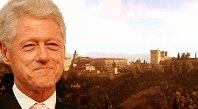 In the late 1990s, a number of things happened simultaneously to throw Granada into the spotlight. The Internet made it possible for many professionals to work online, and therefore live abroad. It also made it possible for people to check out possible places to live in Spain using search engines, and Granada stood out as an ideal place to live. The city was also featured in a number of British TV programmes. Former US president, Bill Clinton, also helped popularise Granada when he revealed that the city was one of his favourite retreats. In a TV interview in Granada in July, 1997, he described the view of the sunset from San Nicolás square in Albaicin as “the best in the world”.
Another important development was that, whereas previously ownership by British expats of villas in Spain had largely been the prerogative of wealthy individuals with a private income, now young families were coming to Spain and buying modest village houses and fincas with the intention of living and working in Spain, learning the language and becoming part of the local community. Previous generations of British expats had, in the main, avoided becoming assimilated into Spanish life. By the year 2000, businessmen and investors had become aware of Granada’s rapidly-growing importance as a destination for visitors to the South of Spain, and as a desirable place to live for those taking up permanent residence in the country. 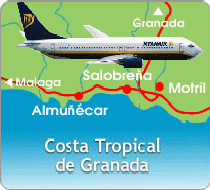 The Irish budget airline, Ryanair, was one of the first companies to recognise Granada’s potential. Plans were already in the pipeline to expand Granada airport to cater for the increasing number of visitors to the city. Ryanair began negotiations with the airport authority to operate direct flights between the airport and London. The company began its Granada operation at the beginning of 2005, and the service was quickly expanded to include flights to and from Liverpool and East Midlands (Nottingham). Other routes are expected to be added soon, including a Granada-Dublin service. The British budget airline company, Monarch, was quick to follow Ryanair’s lead, and now offers direct daily flights between Granada and London Gatwick. The Irish budget airline, Ryanair, was one of the first companies to recognise Granada’s potential. Plans were already in the pipeline to expand Granada airport to cater for the increasing number of visitors to the city. Ryanair began negotiations with the airport authority to operate direct flights between the airport and London. The company began its Granada operation at the beginning of 2005, and the service was quickly expanded to include flights to and from Liverpool and East Midlands (Nottingham). Other routes are expected to be added soon, including a Granada-Dublin service. The British budget airline company, Monarch, was quick to follow Ryanair’s lead, and now offers direct daily flights between Granada and London Gatwick.
The advent of daily flights between Granada and the UK, the opening of the new motorway to the coast, and the massive expansion of the ski resort combined to establish Granada as an important Spanish destination. Granada was now just as accessible as Malaga to British and Irish visitors, and to visitors from other parts of Europe. 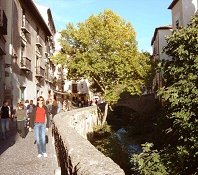 For families, in particular, the city of Granada had a great deal to recommend it. It is safe (one of the safest cities in Europe, which is obviously an important consideration for parents of young children), the air is clean, and, with a population of just over a quarter of a million, it is most peoples’ idea of the perfect size for a city: large enough to provide everything a visitor or resident might wish for in the way of shops, restaurants, bars, nightclubs, cinemas, art galleries, museums, libraries, parks and other amenities, yet not so big as to be cold or anonymous. In fact Granada is a vibrant, cosmopolitan city that somehow manages to retain the charm and intimacy of a village. The schools are superb, and Granada University is regarded as one of the best in the world. Add to that an excellent medical service, a reliable transport system and a cost of living that is one of the lowest in Europe, and Granada’s attraction as a place to live is obvious. For families, in particular, the city of Granada had a great deal to recommend it. It is safe (one of the safest cities in Europe, which is obviously an important consideration for parents of young children), the air is clean, and, with a population of just over a quarter of a million, it is most peoples’ idea of the perfect size for a city: large enough to provide everything a visitor or resident might wish for in the way of shops, restaurants, bars, nightclubs, cinemas, art galleries, museums, libraries, parks and other amenities, yet not so big as to be cold or anonymous. In fact Granada is a vibrant, cosmopolitan city that somehow manages to retain the charm and intimacy of a village. The schools are superb, and Granada University is regarded as one of the best in the world. Add to that an excellent medical service, a reliable transport system and a cost of living that is one of the lowest in Europe, and Granada’s attraction as a place to live is obvious.
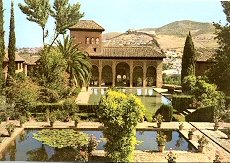 Huge sums of money – EU, local government and private - have been invested in Granada (into road and transport improvement, restoration of old buildings, construction of parks, swimming pools, shopping centres, sports facilities and various other cultural and artistic projects). A tram system is planned for the city, and construction is already underway for a cable car linking the city centre with the ski resort.
The downside to Granada city's growing popularity is that, with so many people wishing to live here, property prices in Spain have risen at a faster pace than anywhere else in Europe over the past five years - even outstripping the UK market. Research by mortgage lender Halifax found the cost of a Spanish home had doubled between 2001 and the end of 2006, leaping by 57% in the past two years alone. Between 2007-2008 the domestic Spanish property market - that is, properties bought by Spaniards (Spain has a higher percentage of homeowners than any other eurozone nation, with 82% of its inhabitants being owner-occupiers) - came to a virtual standstill, primarily as a result of developers and construction companies building too many houses, and partly as a knock-on effect of the economic recessions in the US and Britain. However, the slowdown in the Spanish market is seen by most economists as a temporary lull, and even as a positive and necessary adjustment which prevented property prices from spiralling out of control. In some areas, values had trebled over the past several years. Apartments in the centre of Granada that could be bought for as little as 75,000 Euros in 2003 were being snapped up for upwards of 200,000 Euros by 2006. At the time of writing (Autumn 2008) the property market is still in slowdown mode. However, as the market is expected to recover within the next 1-2 years (when prices will almost certainly begin to accelerate again), there will probably never be a better time to buy property in Spain. 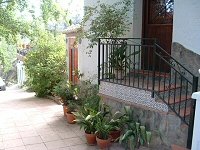 The good news is that it is still possible to find inexpensive properties here, especially in villages just outside the city. There are also opportunities for those willing to buy and reform dilapidated properties, or to buy and rebuild ruins. And property values are lower the further one looks outside the city. For those who are prepared to live 20 miles or so outside Granada, there are still many bargains to be had – though probably not for very much longer. In comparison with countries like the UK and Ireland, of course, property values in Spain are still relatively low.
Spain’s best-kept secret – the city of Granada has always been known to Spanish natives as “the jewel in the crown” – has finally been discovered by the outside world. 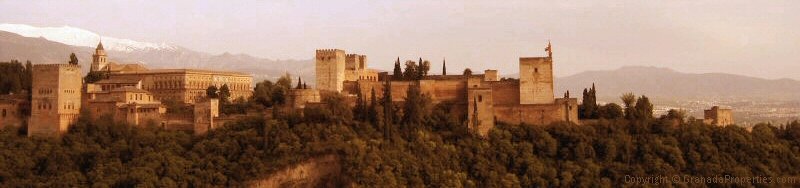 |